About
My connection with the forest began early. My father, the photographer Nanak Dhingra, took me into India’s national parks from the age of seven — Corbett, Kanha, Bandhavgarh, Ranthambhore and many more — and by my early teens I was making photographs of my own. One of the first I still care about was made in Ranthambhore in 1997: the tigress Machli, then a cub, walking beside her mother. I have been going back to the forests ever since.
Tigers remain the centre of my work, but the pictures that stay with me are the ones that place an animal in its world — a tigress in the dry forest at dawn, painted storks on a still lake, a chital lit from behind against the dark. I photograph mostly in black and white. Stripped of colour, what is left is light, form and the moment.
Away from wildlife I carry a small camera through the cities I travel to for work — Delhi, Udaipur, Dubai and further afield — and those street and architecture frames form the other half of this site.
Alongside photography I have spent two decades in international business in the industrial and process sectors, working across the Middle East, Africa, Europe, South America and Southeast Asia. Photography is what I do with the rest of my time, and it continues a legacy that now spans two generations.
Selected for the LFI Gallery · Nominee, Refocus Black & White Awards 2026 · Featured by Leica Camera India
Equipment
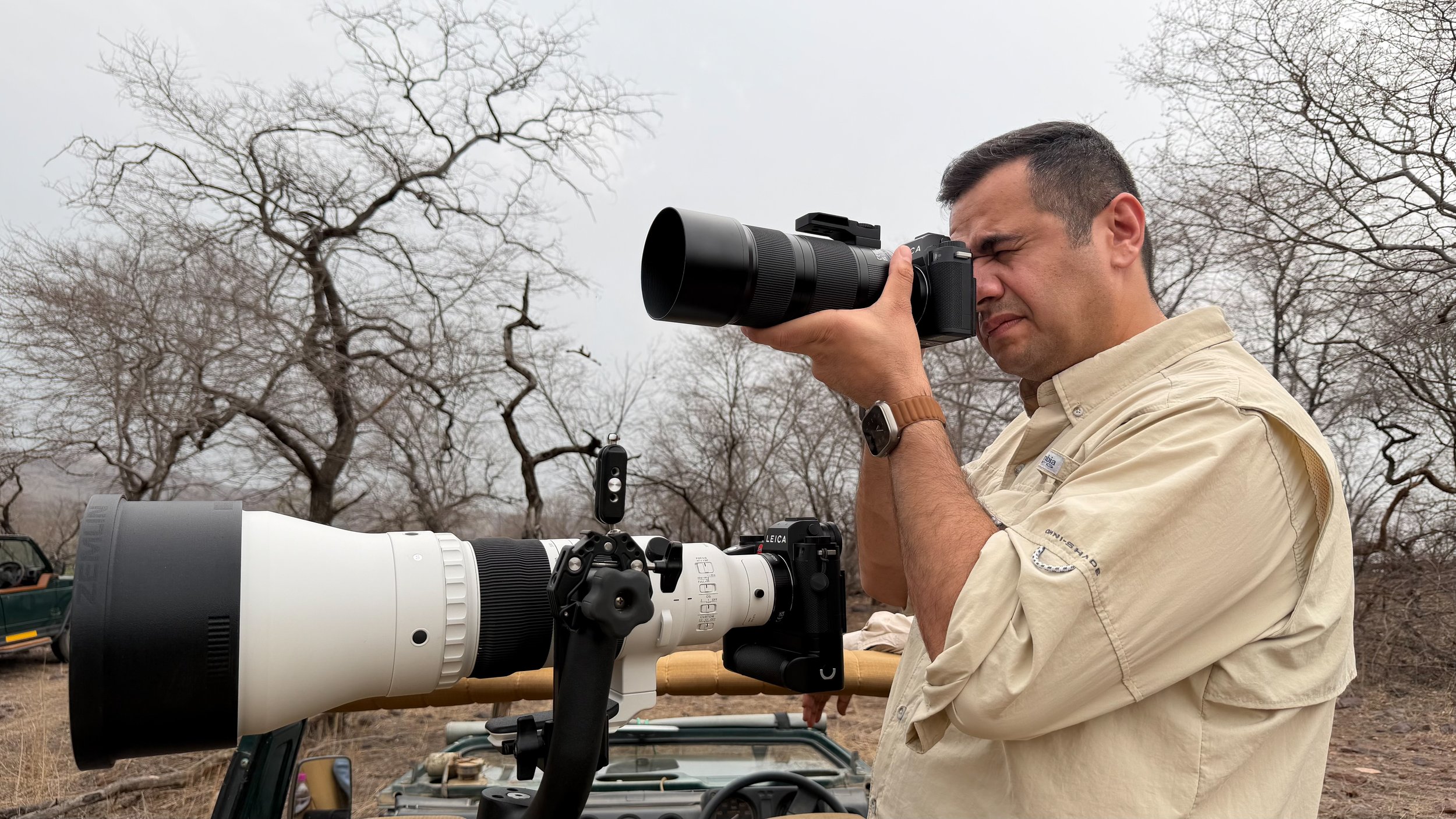
Most of the wildlife on this site is made on the Leica SL3-P and SL3-S with the Sigma 300–600mm f/4 and Leica 70–200mm; the street work is from the Leica Q3 Monochrom. A Canon R5 Mark II and a Fujifilm GFX100RF cover what those don’t. More on the cameras: Wildlife with the Leica SL.